Custom Thermoformed Trays for Michigan Manufacturers
You are not looking for another brochure about reshoring. You are standing up a line, moving work back to the Midwest, or changing how a part flows through assembly—and someone just asked where the trays are.
Custom thermoformed trays and protective packaging are easy to postpone until launch pressure hits. By then, generic bins, foam cut by hand, or trays sized for the old part cost you scrap, downtime, and rework. The fix is not a bigger catalog SKU. It is packaging shaped to your part, your workstations, and how material actually moves on your floor.
4K Custom Thermoforming builds custom trays, dunnage, and formed packaging for manufacturers in Michigan and across the Midwest—from first article through repeat production.
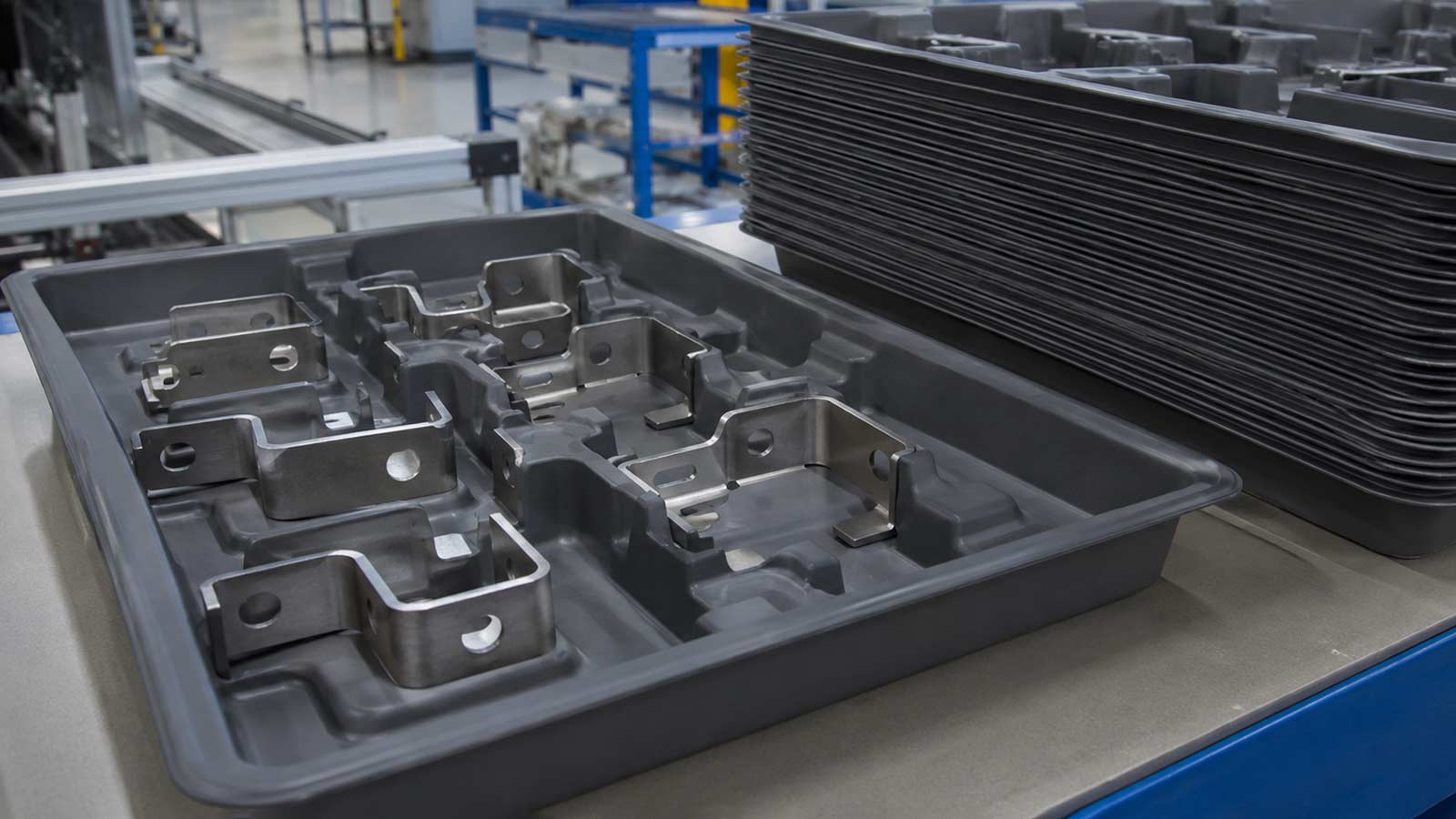
The Problem: Production Changes Faster Than Packaging
Manufacturing investment in Michigan and the broader Midwest—new lines, facility expansions, supplier diversification into defense and aerospace, EV, and adjacent sectors—creates work far beyond the headline plant. Every added or relocated process introduces a chain of handling steps: part, tray, workstation, transport, storage, next operation.
Engineering and operations focus on equipment, quality plans, and staffing first. Trays and dunnage often sit on a punch list. That is rational until the first shift discovers parts sliding in oversized totes, nesting that does not match the new geometry, or returnable packaging still sized for a previous revision.
The pain shows up as scratched finishes, mis-picks, stack instability, and slow changeovers—not as a line item labeled “packaging,” but as measurable waste on the floor.
Why It Happens on New and Transferred Lines
Packaging gaps appear for predictable reasons, not because teams are careless.
- Part revisions lag tooling. The line is built around Rev C, but trays still reflect Rev B pockets and stack height.
- Volume is unknown at kickoff. Launch might need 500 trays, then 2,000 after ramp—decisions get deferred.
- Multiple disciplines own pieces. Quality wants traceability, logistics wants returnables, manufacturing wants one-hand loading—no single spec exists yet.
- National suppliers optimize for scale. Very large plastics companies may pass on mid-volume custom programs that do not fit their minimums or lead-time models.
- Timing is compressed. Public investment and supplier-transition programs accelerate schedules; secondary suppliers feel the squeeze last.
The trigger for custom thermoforming is not “this company already uses thermoforming.” It is adding, transferring, or redesigning a production process—when someone realizes they need 500, 2,000, or 10,000 trays with consistent nests and stack geometry.
How Custom Thermoformed Trays and Packaging Solve It
Thermoforming shapes heated plastic sheet over a custom tool so each cavity matches your part profile. For line startup and WIP, that repeatability matters more than cosmetic flash: the same pocket depth, the same clip clearance, the same stack height tray after tray.
Typical solutions we develop with plant and quality teams include:
WIP and assembly trays
Hold parts at workstations, inspection, and sub-assembly without mixed-SKU confusion.
Returnable dunnage
Cycle between your facility and suppliers with durable nests built for repeated handling.
Material-handling and shipping trays
Support internal transport, staging racks, and outbound shipment with separators that protect edges and coatings.
Protective covers and launch packaging
Bridge the gap until final packaging is frozen—especially on new-product introductions.
Tooling for thermoformed trays is generally less capital-intensive and faster to iterate than injection molds, which fits launch volumes and design changes common on new lines. For deeper capability on scale programs, see our article on high-volume industrial thermoforming and our custom parts packaging and protective covers services.
Secondary Needs: You Do Not Have to Supply the OEM Directly
Opportunity often sits one tier away from the announced expansion. A new manufacturing line in Van Buren Township, a composites facility in Cass County, or an automotive supplier diversifying under Michigan’s Auto Supplier Transition Program still generates the same secondary requirements: trays for components, kits for assembly cells, and returnables between plants.
You may never ship to the headline customer’s dock—but you still need packaging that matches your part and your process. That is where a focused thermoforming partner earns its place on the supplier list.
Why a Regional Michigan Manufacturer Is an Advantage
Custom tray programs in the hundreds to low tens of thousands of units are worthwhile for a regional thermoformer—and awkward for suppliers built only for massive, standardized runs. Working with 4K Custom Thermoforming in Byron Center, Western Michigan, gives expanding manufacturers practical advantages:
- Direct engineering conversation. Share CAD, sample parts, or a rough nest sketch; get tooling feedback without a long ticket queue.
- Faster iteration before startup. When the line date moves, tray geometry can move with it—critical for first-shift success.
- Midwest logistics. Shorter ground transit for samples, trial quantities, and replenishment than sourcing from distant coasts.
- One partner from prototype to repeat orders. Aligns with how Michigan and Midwest plants actually launch—pilot, ramp, then steady state.
We support manufacturers across Michigan, Indiana, Ohio, Illinois, and beyond. Proximity matters most when packaging is on the critical path to production readiness.
Frequently Asked Questions
Plan Trays Before Your Line Starts
If you are expanding, reshoring, or adding a production line in Michigan or the Midwest, tell us about your part and handling sequence. We will help you scope custom thermoformed trays and protective packaging that fit the way you actually build—not how a catalog assumes you build.