Thermoformed Packaging for Data Centers and AI Hardware
The Challenge of Scaling Hardware Production
As demand for AI infrastructure and data center capacity continues to accelerate, the pressure isn’t limited to compute performance. It shows up on the production floor — in how components are handled, protected, and moved between processes.
Server components, GPU assemblies, power supplies, and supporting hardware are not only high-value, but often sensitive to impact, contamination, and electrostatic discharge. At the same time, production volumes are increasing, and handling methods that worked at lower scale begin to introduce inefficiencies, inconsistencies, and risk.
This is where packaging transitions from a passive necessity to an active part of the manufacturing process.
Where Thermoforming Fits in Production Environments
Thermoformed packaging is often evaluated as a shipping solution, but its real value becomes clear inside the facility.
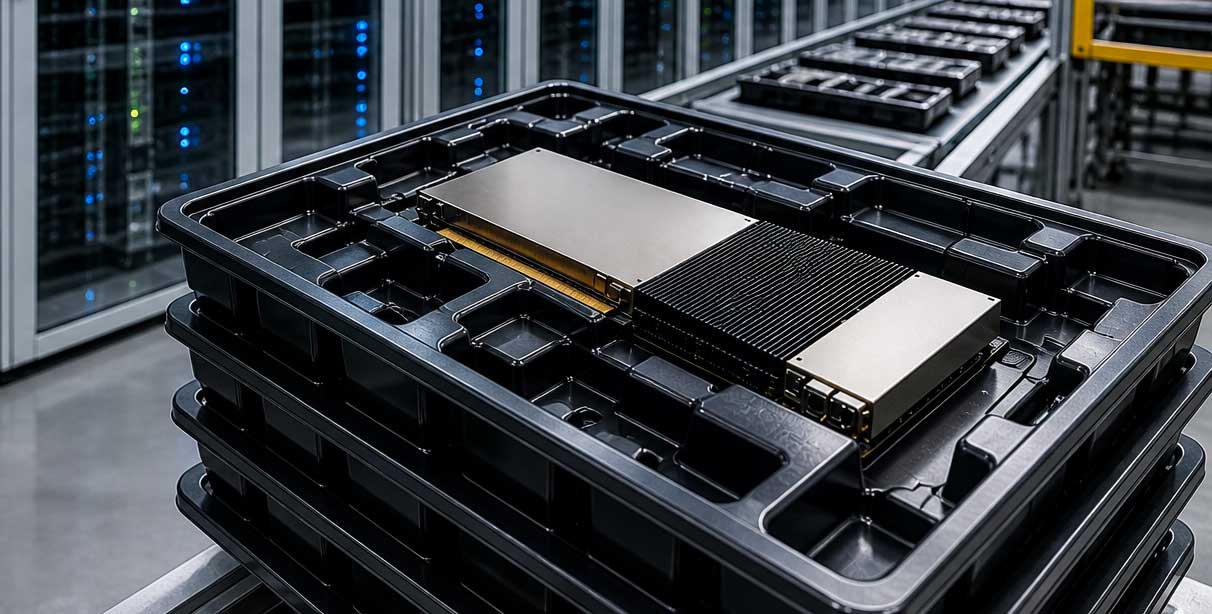
In high-volume environments, thermoformed trays function as repeatable, purpose-built carriers for work-in-progress (WIP). They provide defined part orientation, consistent spacing, and predictable handling characteristics across manual and automated processes.
Instead of adapting production around generic packaging, thermoforming allows the packaging to be designed around the product and the workflow.
Built Around Real Hardware Use Cases
AI and data center hardware introduces a wide range of geometries and sensitivities. Flat components, dense assemblies, and irregular shapes all require different handling approaches.
Thermoformed trays can be engineered to:
- Secure GPU boards and server blades during transport between stations
- Protect power supply units and electrical components from shifting or impact
- Maintain orientation for robotic pick-and-place or manual assembly
- Stack efficiently to reduce footprint in high-density production areas
The result is not just protection, but improved consistency across the entire handling process.
Material Selection and Performance Considerations
Material choice plays a critical role in performance, especially in electronics-related applications.
Common materials include:
- HIPS (High Impact Polystyrene): Cost-effective, good rigidity for general-purpose trays
- PET: Durable with good impact resistance and clarity options
- PVC: Versatile and formable for more complex geometries
- ABS: Higher strength and temperature resistance for more demanding applications
Thickness typically ranges from lighter gauge for high-cavity, disposable applications to heavier gauge for reusable dunnage systems.
For sensitive electronics, ESD-safe materials can also be incorporated to reduce the risk of electrostatic discharge during handling and transport.
Designed for Repeatability at Volume
At scale, small inconsistencies become operational problems.
Thermoformed packaging produced through roll-fed processes is inherently suited for high-volume manufacturing. Each cycle produces consistent parts with tight repeatability, supporting standardized workflows and reducing variability on the line.
Integrated trimming and forming processes ensure that each tray meets the same dimensional expectations, which is critical when interfacing with automation or standardized storage systems.
Tooling Flexibility and Iteration
Production environments change. Components evolve, tolerances shift, and processes are refined.
Thermoforming supports this reality through flexible tooling options:
- Existing dies can often be reused or modified
- New tooling can be developed around updated part geometries
- Iterations can be made without completely restarting the process
This allows packaging to evolve alongside the product, rather than becoming a constraint.
Supporting Regional Manufacturing Supply Chains
For manufacturers operating in the Midwest and surrounding regions, proximity matters. Shipping distances, turnaround times, and the ability to collaborate on design adjustments all impact production efficiency.
Thermoformed packaging produced within the region supports faster response times and better alignment with ongoing manufacturing needs.
A Practical Approach to Packaging in High-Growth Sectors
In data center and AI hardware production, packaging is no longer just about containment. It directly affects throughput, handling efficiency, and product protection at scale.
Thermoforming offers a practical, production-aligned approach — one that integrates into existing workflows while supporting the increasing demands of modern hardware manufacturing.
Discuss Your Data Center or AI Packaging Project
Tell us about your components, handling steps, and shipping requirements. We will follow up to explore tray or insert options that fit your program.