When Thermoforming Is a Better Alternative to Injection Molding
Many Products Don't Actually Need Injection Molding
When engineers begin designing a plastic part, injection molding is often the first manufacturing process that comes to mind. It produces excellent parts, but it also requires a significant investment in tooling before the first production piece is ever made.
For many products, that investment simply isn't necessary.
Thermoforming can produce parts with a clean, professional appearance while dramatically reducing tooling costs and shortening lead times. If your product doesn't require the extreme tolerances or complex internal features that only injection molding can provide, thermoforming may deliver a better overall return on investment.
Why Tooling Costs Matter
Injection molding requires hardened steel or aluminum molds capable of withstanding thousands—or even millions—of injection cycles. Those molds are precision-machined and represent a substantial upfront investment.
That investment makes sense when producing hundreds of thousands of identical parts.
It becomes much harder to justify when:
- You're launching a new product.
- Demand is still uncertain.
- Design revisions are likely.
- Production volumes are in the hundreds or low thousands.
In those situations, spending tens of thousands of dollars on tooling can delay the project before manufacturing even begins.
A Different Approach
Thermoforming starts with a heated plastic sheet that is formed over a precision tool using vacuum and pressure.
Because the tooling is significantly simpler, it costs far less to manufacture.
That means you can:
- Bring products to market sooner.
- Spend less capital upfront.
- Make design improvements without replacing an expensive mold.
- Reach profitability faster.
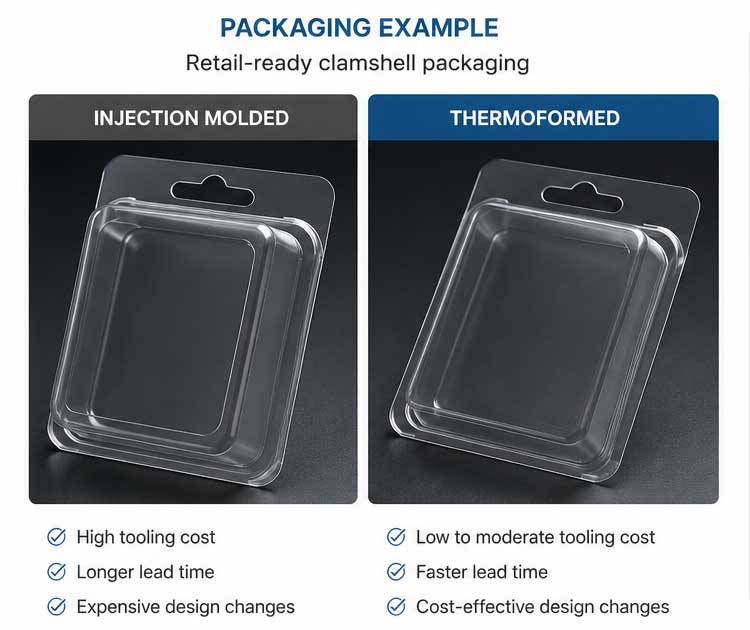
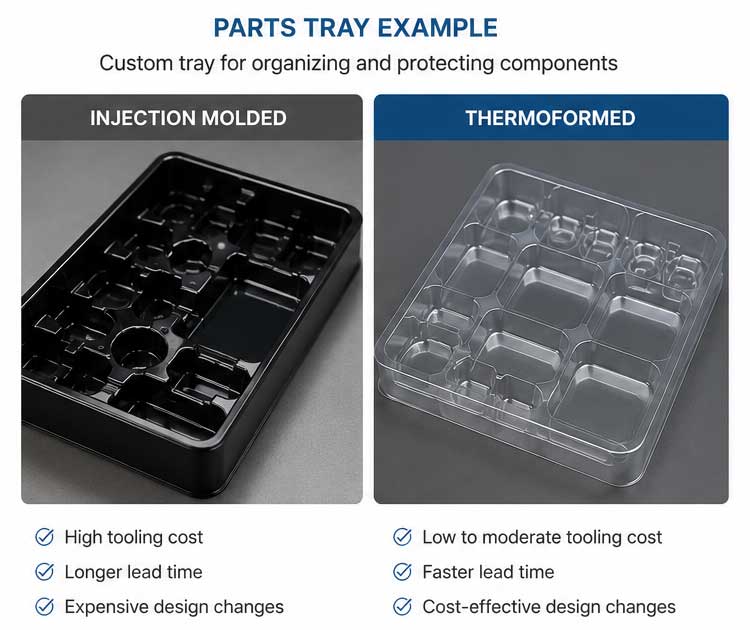
Injection Molding vs. Thermoforming
| Injection Molding | Thermoforming | |
|---|---|---|
| Tooling Cost | Very High | Low to Moderate |
| Lead Time | Typically 8–16 weeks | Often 2–6 weeks |
| Design Changes | Expensive | Much less expensive |
| Best Production Volume | Very High | Low to Medium |
| Development Speed | Slower | Faster |
You May Be Surprised by the Finish
One of the biggest misconceptions about thermoforming is that it produces parts that look inexpensive.
Modern thermoforming can create:
- Smooth cosmetic surfaces
- Crisp edges
- Professional product housings
- Durable trays and enclosures
- Retail-ready packaging
- Large structural components
Many customers are surprised by how closely a properly designed thermoformed part resembles an injection molded product.
When Thermoforming Is the Better Choice
Thermoforming is often the better manufacturing process when you need:
- Faster Product Launches. Waiting months for tooling can delay revenue. Thermoforming dramatically shortens that timeline.
- Lower Development Risk. Need to make design revisions? Updating thermoforming tooling is generally far less expensive than modifying an injection mold.
- Lower Capital Investment. Instead of committing a large portion of your budget to tooling, invest that money in inventory, marketing, or product development.
- Medium Production Volumes. Not every product needs a million-piece production run. Many successful products are manufactured in quantities where thermoforming provides the better overall value.
Is Your Part a Good Candidate?
Thermoforming works especially well for:
- Equipment housings
- Medical device trays
- Industrial packaging
- Automotive components
- Machine covers
- Consumer product packaging
- Protective covers
- Large plastic enclosures
If you're unsure whether your part is a good fit, we can review your design and provide recommendations.
There is no obligation, and you may discover a significantly more cost-effective way to manufacture your product.