Thermoformed Battery Trays in Production Environments
Intro
In EV manufacturing, battery modules are in constant motion. They move from assembly to testing, from one facility to another, and often through multiple handling steps before final integration. The trays carrying them are rarely given much attention—until they start creating problems.
At low volumes, those problems tend to stay contained. A tray that fits “well enough” or stacks “close enough” might not interrupt the process. But as production ramps, small inconsistencies begin to surface in more visible ways. Modules shift during transport, operators adjust their handling to compensate, and stacking inefficiencies start to consume space and time. What was once a minor packaging detail becomes a variable inside the production system.
Why Thermoformed Battery Trays Work
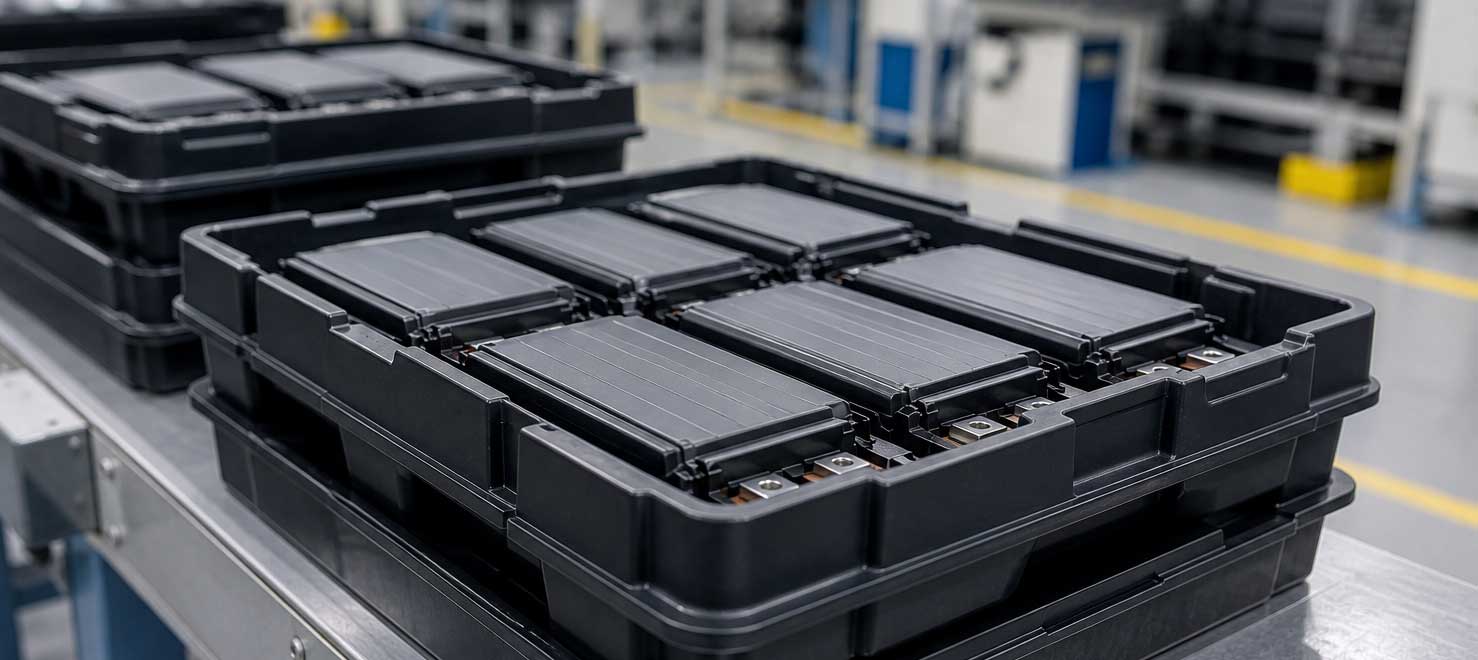
Thermoformed trays tend to perform well in this environment because they are inherently repeatable. Once the geometry is established, every tray produced follows that same profile with a high degree of consistency. That predictability matters when parts need to land in the same position every time, whether they are being handled manually or by automation.
There is also a structural advantage in how material is distributed. Properly designed thermoformed trays can provide rigidity where it is needed while remaining relatively lightweight. This balance supports both protection and usability, particularly in applications where trays are handled frequently or cycled through returnable systems.
Over time, this consistency reduces the number of small adjustments operators and systems have to make. The tray becomes a stable, predictable interface rather than something that needs to be worked around.
Where This Shows Up in Production
These trays tend to appear at multiple points in the production flow. Inside the plant, they are often used for work-in-progress movement, carrying modules between assembly, inspection, and testing stations. In these cases, the tray is part of the rhythm of the line, moving with the product and supporting throughput.
They also show up in staging areas, where components are queued for the next operation. Here, stackability and footprint efficiency start to matter more, especially when floor space is constrained.
Beyond the facility, thermoformed trays are commonly used in shipping between suppliers and OEMs. In returnable packaging systems, they cycle repeatedly through the same routes. This introduces a different set of expectations around durability and consistency, since the same tray may be used hundreds of times under varying conditions.
What Changes at Higher Volumes
As volumes increase, the tolerance for inconsistency drops. A tray that varies slightly in dimension or stiffness might not be noticeable in a short run, but across thousands of units, that variation begins to show up in stacking behavior, part fit, and handling.
At scale, inefficiencies become patterns. If trays do not nest or stack cleanly, operators spend more time correcting them. If parts do not seat consistently, there is a higher risk of movement or damage during transport. If each batch of trays behaves slightly differently, downstream processes have to absorb that variation.
This is where production-ready solutions separate from temporary ones. The expectation shifts from “works most of the time” to “works the same way every time.”
Material / Technical Considerations
Material selection plays a direct role in how these trays perform over time. In many cases, the choice is less about a single property and more about how the material behaves across repeated use.
Rigid materials like high impact polystyrene are often used where cost control and dimensional stability are priorities. In applications where trays are handled more aggressively or cycled repeatedly, materials with higher impact resistance, such as polyethylene, tend to hold up better.
There are also cases where electrostatic discharge becomes a concern, particularly when modules include sensitive electronics. In those environments, material selection has to account for both mechanical and electrical behavior.
Thickness is another practical consideration. Increasing thickness can improve rigidity, but it also affects weight, forming time, and overall efficiency. The right balance depends on how the tray is used, not just how it looks on paper.
Designing for Process, Not Just Fit
A common mistake is to treat tray design as a simple exercise in matching the part geometry. In reality, the tray has to function within a broader process.
How it is picked up, how it is stacked, how it is separated from other trays, and how it interacts with operators or automation all influence the final design. Features like handholds, stack stops, and nesting geometry are not secondary—they are central to how the tray performs day to day.
A design that works well in isolation can still create friction in production if it does not align with the actual workflow. The goal is not just to hold the part securely, but to support the movement of that part through the system with as little resistance as possible.
Supply and Consistency Considerations
From a procurement perspective, the conversation often shifts over time. Initial orders tend to focus on fit, function, and cost. As production stabilizes, consistency becomes more important.
Trays need to match previous orders without variation so they integrate seamlessly into existing processes. Lead times need to be predictable so inventory planning remains stable. Over longer programs, the ability to maintain consistent output across multiple production runs becomes a key factor.
At that point, the tray is no longer a one-time purchase. It is part of an ongoing supply relationship that supports the continuity of production.