Greenhouse Automation Increases Demand for Standardized, Equipment-Compatible Growing Components
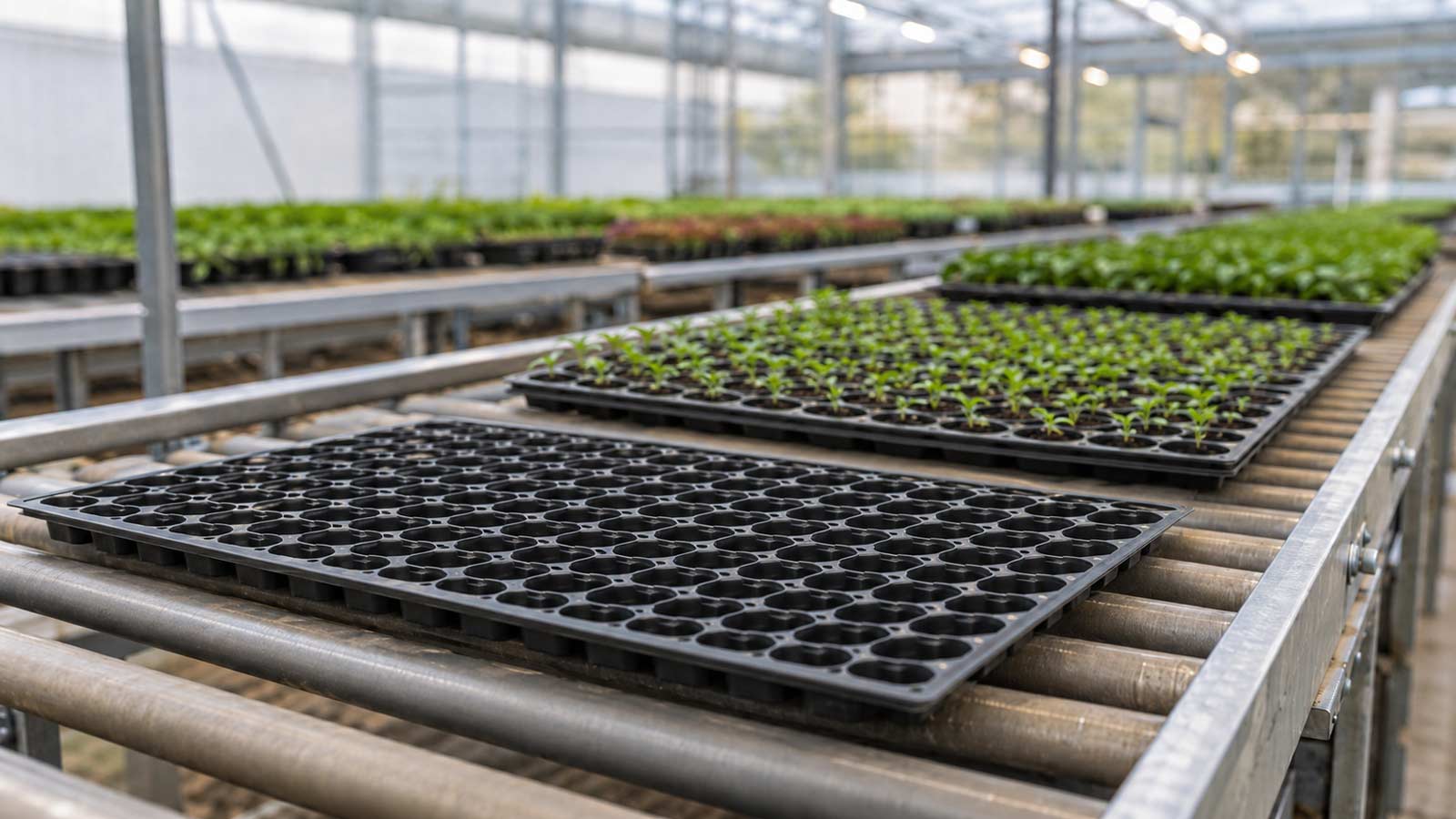
Commercial greenhouses and indoor farms are investing in automated monitoring, conveyor transport, mechanized filling, transplant lines, and robotic handling to hold down labor cost and improve repeatability. As those systems mature, growing containers—trays, inserts, and flats—are treated less like consumables and more like line equipment that must meet dimensional and compatibility requirements.
When a tray wobbles on a conveyor, cells miss a dibbler or gripper, or spacing drifts after thousands of cycles, the problem often sits at the container layer—not only in software or sensors. For automation to run reliably, trays need consistent footprint, cell pitch, drainage, and stiffness from lot to lot.
That push toward standardization does not mean one universal tray for every crop. It means containers specified for your benches, flood systems, and handling equipment. Most operations compare three sourcing paths: generic nursery trays, modified off-the-shelf products, and purpose-designed thermoformed trays and inserts.
What “Equipment-Compatible” Means on the Greenhouse Floor
Equipment compatibility is practical, not abstract: the container must repeat the same behavior through each station in the workflow. Automated and semi-automated lines—vision counting, belt or roller conveyors, flood benches, transplanters, and pick-and-place robots—all depend on dimensional consistency and predictable handling features.
- Footprint and height — align with bench rails, rack slots, cart decks, and conveyor guides
- Cell spacing (pitch) — stable centers for filling, transplant tools, monitoring, and canopy planning
- Drainage — hole size and layout matched to flood, ebb-and-flow, or overhead irrigation without media washout
- Nesting and denesting — repeatable stack behavior for storage, shipping, and returnable loops
- Rigidity — enough stiffness when lifted, clamped, or pushed by automation without chronic flex
- Handling features — lips, flanges, or edges suited to conveyor transfer and robotic pickup where used
Trays chosen only by cell count for manual bench work are often “close enough” until the line speed rises. At that point, small geometry variances show up as jammed conveyors, rework at transplant, or unreliable counts—not as a single failed component.
Where Containers Meet the Line: Filling, Conveyors, and Transplanting
Compatibility questions usually surface at specific stations. These are the stages growers and integrators ask about when evaluating trays:
- Filling and dibbling — cell depth, opening diameter, and row alignment must match filling heads or dibblers so media volume and plug position stay uniform.
- Conveyor transfer — tray base flatness, overall width, and side features affect tracking, accumulation, and handoff to downstream equipment.
- Transplanting — consistent cell geometry helps semi-automatic and automatic transplant tools seat plugs without crushing or missing cells.
- Spacing through grow-out — fixed pitch supports both mechanical handling and vision-based crop monitoring; drift in container layout forces manual correction or software workarounds.
- Robotic handling — where robots are used, tray rigidity and defined pick surfaces reduce mis-picks; inserts may need separate consideration from outer trays.
Documenting target dimensions, acceptable tolerance, and photos or drawings of existing equipment gives suppliers a clear basis for quoting custom thermoformed trays instead of guessing from a catalog number.
How 4K Approaches Application-Led Tray Design
At 4K Custom Thermoforming, projects start from how plants move through the facility: bench or flood tray size, irrigation method, transplant workflow, and whether trays must nest or return on a closed loop. Thermoforming allows tooling tailored to that operation without injection-mold lead times and capital—while supporting production repeatability once the design is validated.
The comparison that matters on this page is not between thermoforming vendors. It is between generic trays, modified off-the-shelf workarounds, and containers designed against your equipment specification from the start.
Operational Problems Worth Solving in the Tray Design
These are recurring floor-level issues when growing containers were not specified for automation:
Reducing transplant labor
Trays and inserts aligned with transplant equipment reduce hand work per cell. Consistent depth and opening size help tools seat plugs reliably and limit rework.
Maintaining container spacing
When pitch varies, monitoring miscounts, robots miss picks, and canopy management suffers. Custom layouts match bench and handling plans instead of forcing equipment to adapt to a catalog tray.
Moving plants through automated watering
Flood benches and conveyor-fed irrigation need trays that drain predictably, sit flat, and stay stable when saturated. Drain geometry and stiffness belong in the initial spec—not as field modifications.
Preventing tip-over in internal transport
Carts and forklifts expose trays to vibration and uneven floors. Base width, insert integration, and ribbing can improve stability without unnecessary weight.
Standardizing for benches and racks
One footprint across propagation, grow-out, and shipping simplifies inventory and line programming. Custom thermoforming can standardize on facility dimensions rather than a supplier’s legacy catalog size.
Custom cell counts without injection-mold tooling
Injection molding fits very high volumes with fixed geometry. Thermoforming is often practical when a line needs a specific cell count, depth, or insert layout—and room to iterate while automation is still being tuned.
Three Sourcing Approaches Growers and Integrators Compare
Container decisions for automated greenhouses are usually about sourcing strategy, not manufacturing process labels:
| Approach | Typical fit | Common pain points in automated lines |
|---|---|---|
| Generic nursery trays | Quick to source, familiar cell counts, lowest upfront cost for manual growing | Footprint, pitch, and drainage may not match benches, conveyors, or robots; operators compensate with adjustment labor |
| Modified off-the-shelf products | Drilled drainage, trimmed flanges, shims, or hybrid inserts to bridge gaps | Unit-to-unit inconsistency, weak nesting, extra labor, and workarounds that are hard to maintain at scale |
| Custom thermoformed systems | Tray and insert designed to stated equipment and irrigation requirements | Requires upfront design input and tooling; best justified when downtime, rework, or crop loss costs are material |
4K fits projects where the tray geometry must match a defined workflow—single-site commercial houses, propagation specialists, and regional growers standardizing containers across facilities. Commodity suppliers remain the right answer when a generic tray truly satisfies the line; custom work earns its place when compatibility and repeatability are gating automation ROI.
Trays, Inserts, and Materials
Many lines use a durable outer tray for handling plus a replaceable insert for propagation. Thermoforming supports both: inserts tuned for root development and transplant timing; outer trays emphasizing stiffness, drainage channels, and returnable logistics.
Material selection affects wash-down, reuse, and longevity. Food-grade polypropylene options matter where container integrity and reuse are part of the quality story—covered further in our article on food-grade plastics for starter plants. For custom nursery tray capabilities, see horticulture trays.
Monitoring, Energy Use, and Physical Repeatability
Crop monitoring and resource tracking assume plants stay where the system expects them. Trays that hold spacing and orientation make vision and counting outputs easier to trust. Similarly, energy-intensive indoor environments benefit when conveyors and transplanters do not lose cycles to tipped trays, blocked lines, or uneven flood behavior caused by inconsistent drainage.
Information That Speeds Up a Compatibility Review
A useful first conversation is rarely “how many cells.” More often it helps to share:
- Bench, flood tray, or rack dimensions and any conveyor guide widths
- Target cell size, depth, and row/column pitch
- Equipment involved (filler, transplanter, conveyor type, robot end-effector constraints if applicable)
- Irrigation method and drainage expectations
- Whether trays must nest, stack, or run in a returnable loop
- Approximate annual volume and tolerance for design iteration during pilot runs
4K Custom Thermoforming is based in Michigan and works with greenhouse and nursery operations across the Midwest on trays built to stated equipment requirements—not only to stock catalog sizes.
Send bench and conveyor dimensions, cell pitch, and how trays move through filling and transplant—we can discuss whether a custom thermoformed tray or insert fits your line, or point you toward the right next step if a catalog product is sufficient.